
One of the most useful habits I have developed in business is making sure I always have a few experiments running. My general rule is three experiments at any given time. They do not need to be massive changes or expensive ideas. An experiment can simply be trying a new piece of software, testing a small advertising campaign, outsourcing something you have always done yourself or changing the way part of the business operates.
The important thing is that you are not attached to every experiment producing a brilliant result. You are attached to learning something from it.
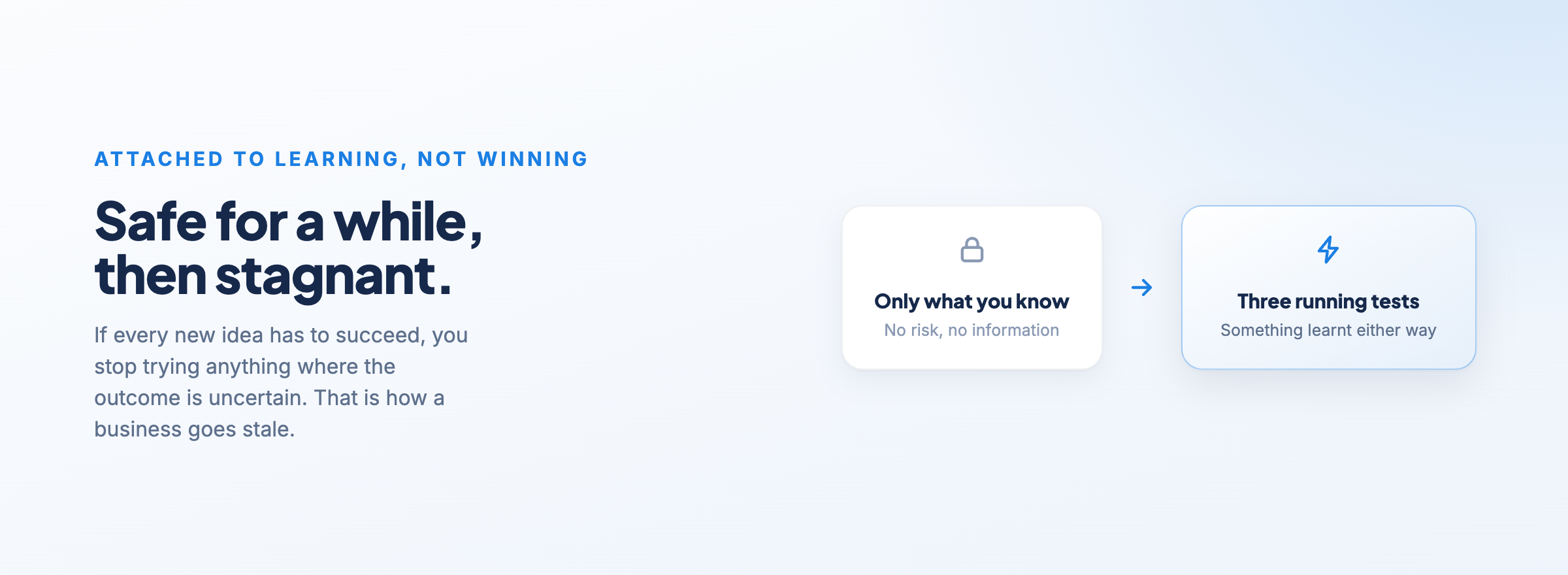
That distinction matters, because if every new idea has to succeed, you eventually stop trying anything where the outcome is uncertain. You start sticking to the things you already know, and that might feel safe for a while, but it is also how businesses become stagnant.
An Experiment Is Just A Sensible Test
When I talk about experiments, I am not suggesting that business owners should constantly gamble with large amounts of money or change things for the sake of changing them. An experiment is simply a controlled way of testing whether an idea might make the business better.
You might try a new software platform for a month and see whether it saves your team time. You might put a small amount of money into Google Ads or Facebook Ads and see whether the right enquiries come through. You could bring in a contractor to take over something the owner has always done and then see whether the time that creates can be used more productively elsewhere.
You are asking a question and then giving yourself a way to find the answer. Does this save time? Does it make the business more profitable? Does it create more enquiries? Does it allow our staff to spend more time doing useful work?
Most Experiments Will Not Work
One of the reasons people avoid experimenting is that they think an unsuccessful test means they have failed. I do not look at it that way at all.
Across the things I have tested in my own businesses and the businesses I work with, a large percentage of experiments do not produce the result we hoped for. It might even be around two-thirds. That does not mean those experiments should never have happened. It means we paid something to learn what does not work so we can put more time and money into the things that do.
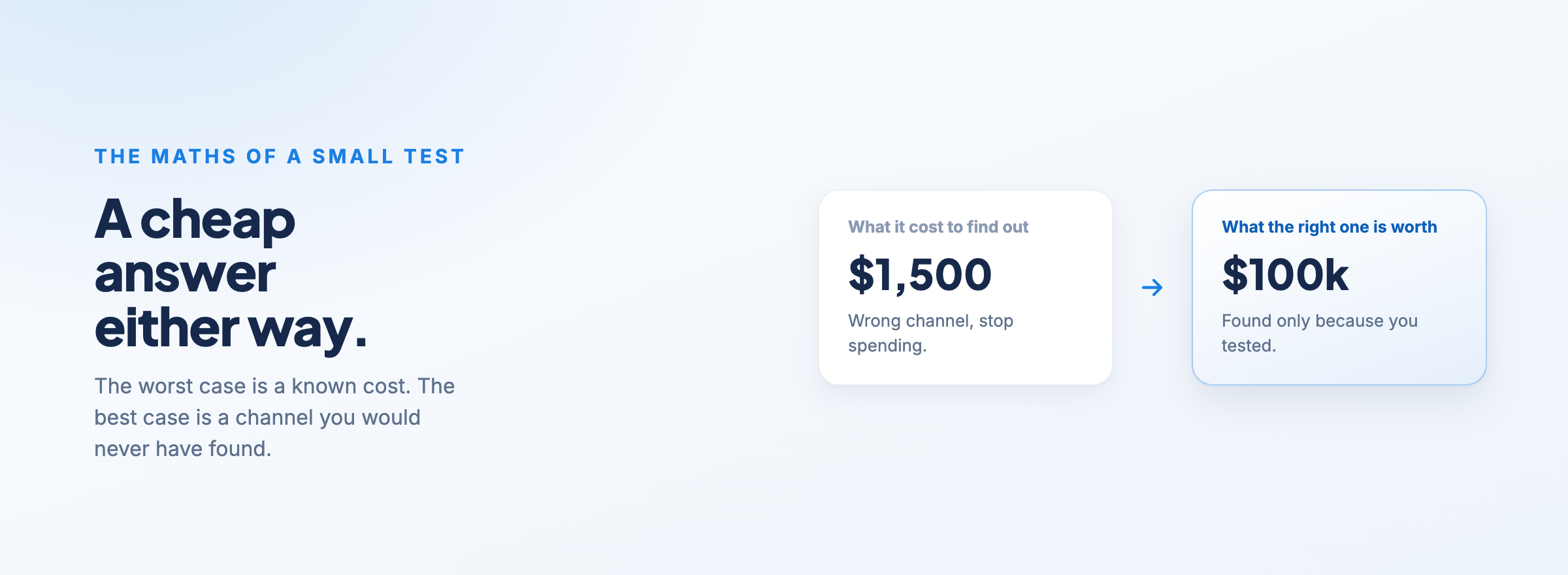
If I spend $1,500 testing a marketing channel and discover that it is completely wrong for my business, I have still learnt something valuable. I now know not to keep putting money into it. Equally, if that $1,500 test identifies a marketing channel that could eventually generate $100,000 in revenue, that small experiment has been enormously valuable.
What I do not want is to spend years never finding out because I was frightened of wasting $1,500.
Start Small And Increase What Works
If you have never used Google Ads before, there is no reason you have to suddenly spend a huge amount of money. You can put a smaller budget behind it, let the campaign run properly and see what happens. Are the right people clicking? Are enquiries coming through? Are those enquiries actually becoming clients?
If the answer is yes, you can put more money behind it. If the answer is clearly no, you stop, work out what you have learnt and try something else.
There are two extremes that cause problems. One is refusing to spend anything because there is no guarantee it will work. The other is spending a fortune before you have any evidence that it works. A sensible experiment sits somewhere in the middle.
Software Is One Of The Easiest Things To Test
Software is particularly useful for experimenting because the initial cost is often quite low. Many platforms have free trials or inexpensive ways to test whether they actually improve anything before you make a bigger commitment.
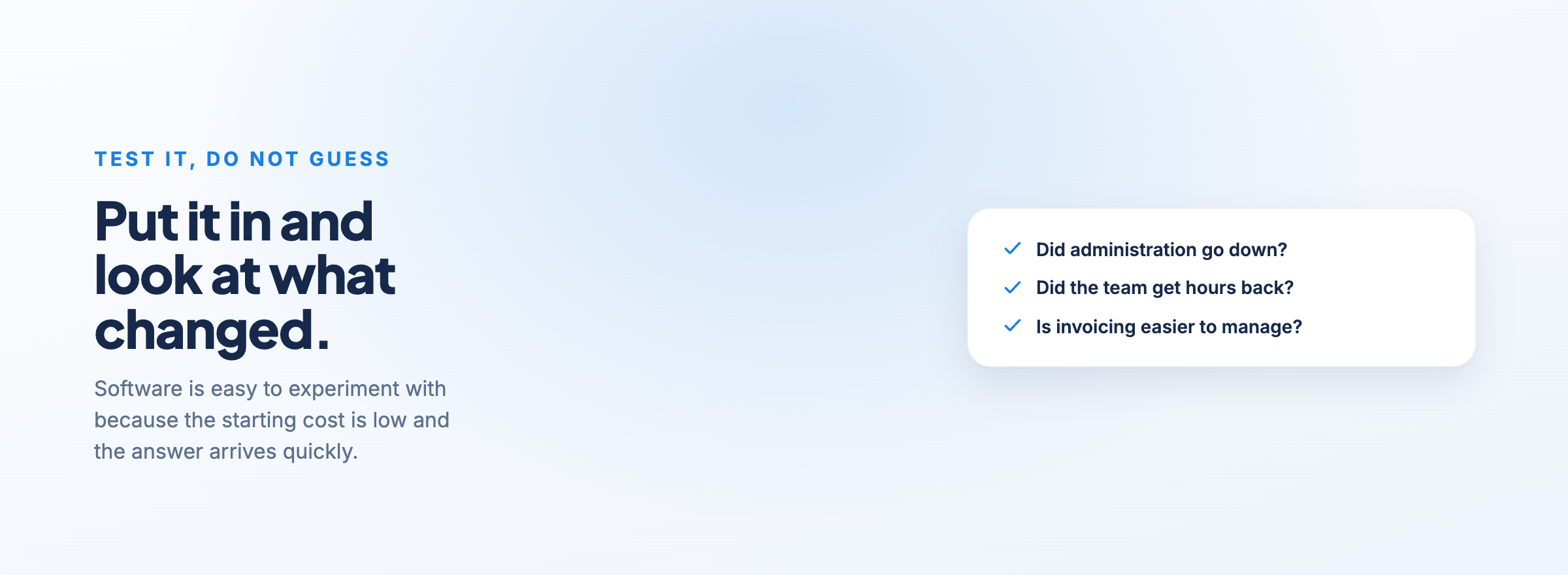
Astalty is a simple example, because you can try the software and see what happens. Does it reduce administration? Does it save the team time? Does it make invoicing or another process easier to manage? If the answer is no, then perhaps it is not the right tool for your business. If the answer is yes and it gives your team hours back every week, you have found something worth keeping.
Sometimes people tell me that their current system is not broken, so they do not see a reason to test anything else. The problem with that logic is that you do not really know whether your system is good simply because it works. You only know that it is functional. You cannot compare what you are currently doing with an alternative you have never tried.
This Matters More When Your Team Has Non-Billable Work
This becomes particularly important in the NDIS, because so much of the work involved in running a provider is not directly billable. Administration still needs to happen. Rostering still needs to happen. Invoicing still needs to happen. None of those things disappear simply because the NDIS is not directly paying you for every minute involved.
If you have a skilled employee spending several hours every week doing repetitive work that software could do reliably, it is worth testing whether that work can be handled differently. The aim is not to replace everything humans do. It is to use people where people actually add value.
Decide What You Are Willing To Lose Before You Start
One thing I find helpful is deciding what an experiment is allowed to cost before I begin. I might say I am willing to put $1,500 into testing something. I know from the beginning that there is a chance I will not get that $1,500 back directly. That makes the decision much easier.
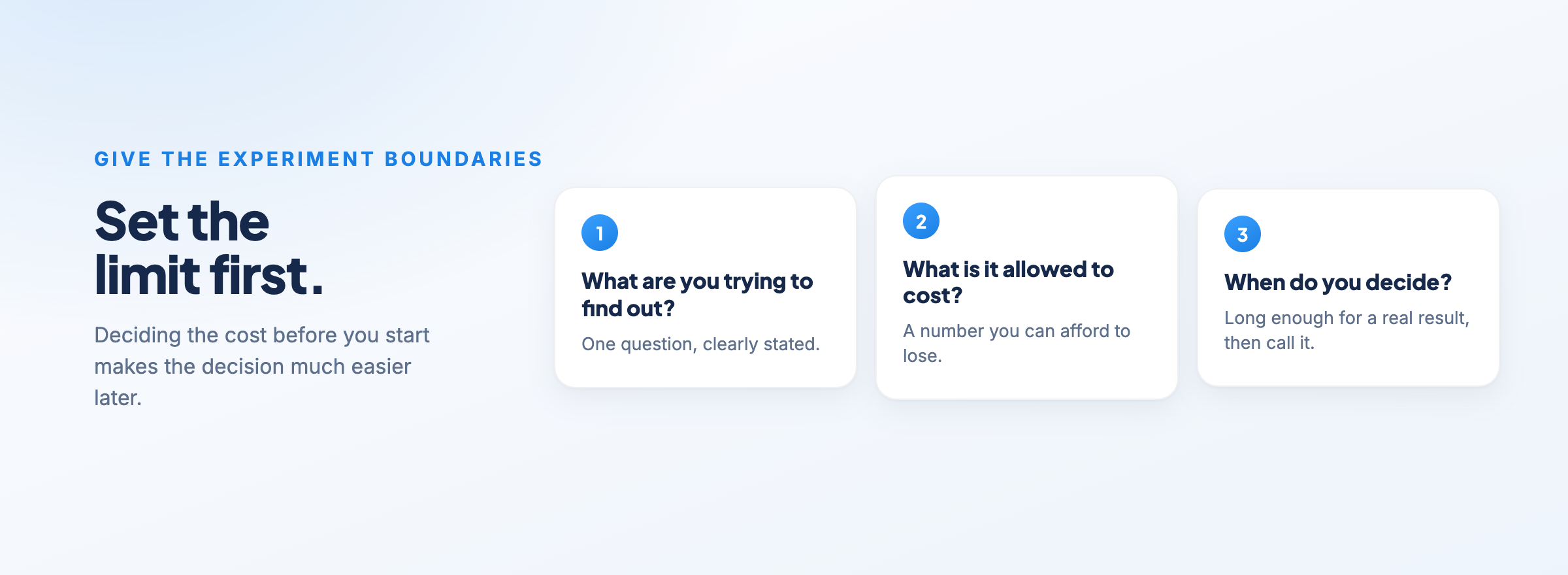
The danger is when something starts as a small test and then continues indefinitely because nobody wants to admit that it has not produced anything useful.
Give the experiment some boundaries. Know what you are trying to find out. Give it enough time to produce a meaningful result and then make a decision. You are not trying to prove that your original idea was right. You are trying to find out whether it was.
Being Willing To Fail Is Part Of Growing
There is a strange idea in business that being responsible means every dollar you spend needs to come back with friends attached. That sounds sensible, but taken too far it stops people from learning.
That is why I like having three experiments running at a time. One might be testing software. Another might be trying a new marketing channel. The third might be changing the way we use a person's time. Perhaps all three fail. Fine. We have learnt three things. Perhaps two fail and one works brilliantly. That one experiment might give us back hours every week or completely change the economics of part of the business.
You do not need every experiment to work. You need to keep learning until you find the ones that do.