
If you run an NDIS business, there's a good chance your software stack looks something like this: one system for participant management, another for rostering, an HR platform like Employment Hero, ELMO or BambooHR for staff documents and onboarding, an e-signature tool like DocuSign for contracts, and a folder of Word docs holding everything together.
None of those tools are bad. They're just not built for NDIS providers, and every one of them is another subscription, another login, and another system your team has to learn.
How we ended up here
Historically, providers didn't have much choice. NDIS software handled participants and billing, and that was about it. So when you needed to track staff compliance documents, you bolted on an HR platform. When you needed contracts signed, you added an e-signature tool. When you needed a position description, you dug out a Word template and filled it in manually.
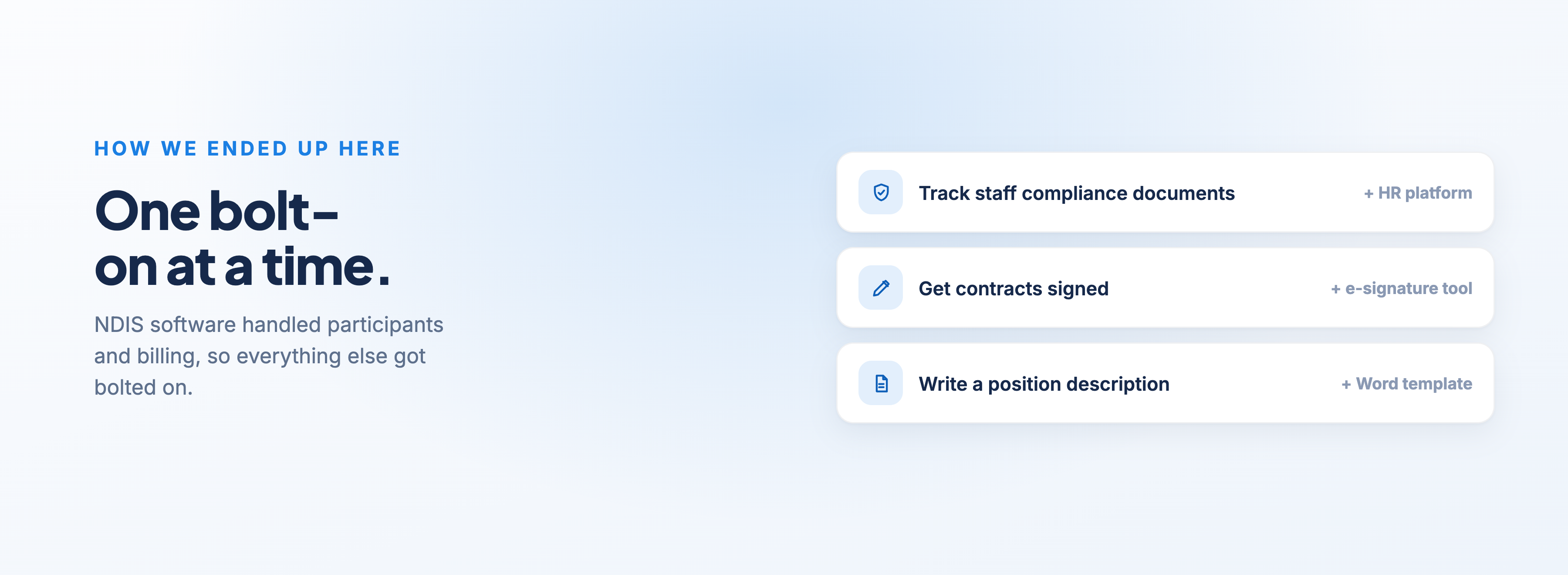
HR software has always been good at the basics: tracking Working With Children Checks, police checks, employee IDs, contracts, and qualifications. That's genuinely useful. The problem was never what these platforms do. The problem is that they sit outside the system where your business actually runs.
System fatigue is a real cost
Every extra system in your stack costs you three times.
First, the subscription itself. Second, the admin time spent double-handling data between systems that don't talk to each other. Third, and this is the one most providers underestimate, the training burden every time you onboard a new staff member.
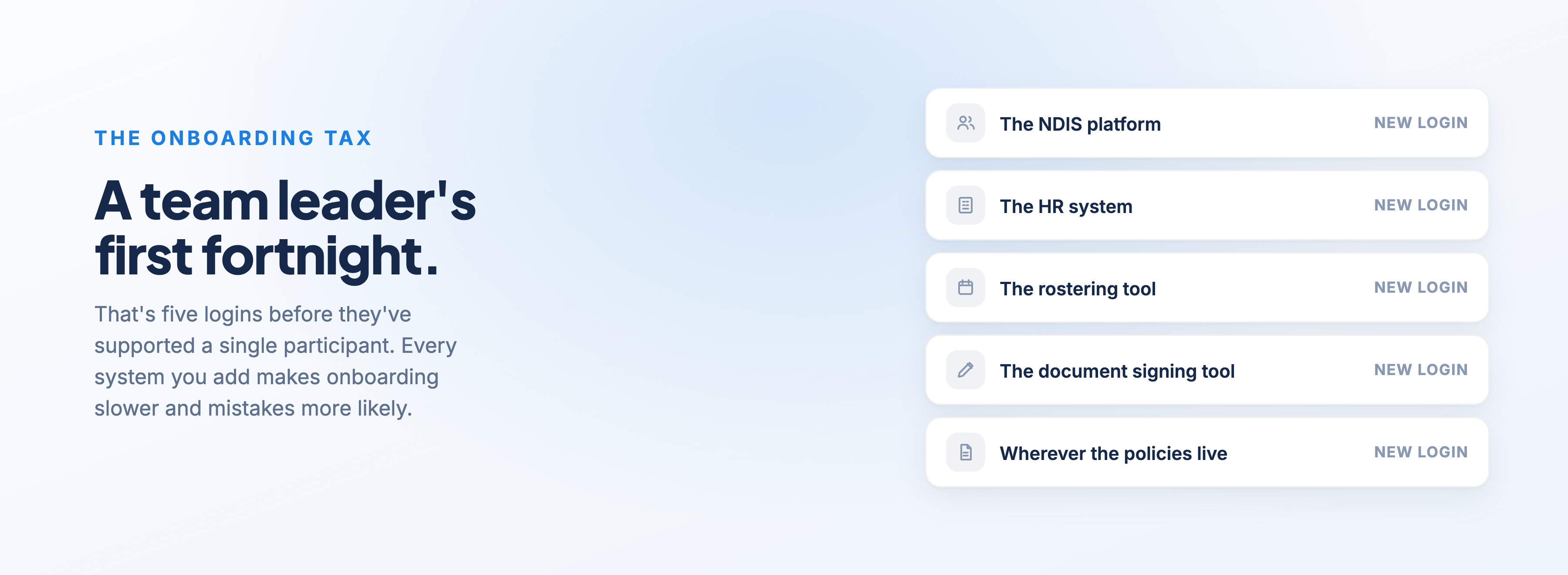
Think about what a new team leader has to learn in their first fortnight: your rostering platform, your HR system, your document signing tool, plus wherever your policies live. That's a lot of logins before they've supported a single participant.
Every system you add makes onboarding slower and mistakes more likely.
The rule when you're choosing software
If you're shopping for a system right now, here's the filter we'd suggest: every new tool should reduce your stack, not add to it.
Two questions worth asking before you sign up for anything:
Can something we already use do this? There's no point running two pieces of software when one of them does it all. Duplicate tools are pure waste.
Does this replace a subscription, or add one? The best software decisions are the ones where you get to cancel something.
How this works in Astalty
We built Astalty so the HR side of running a provider lives in the same system as everything else. Here's what that looks like in practice.
Contracts and position descriptions, without the Word doc
You can pre-build templates in Astalty for your employment contracts, position descriptions, and any other staff document. Set them up once with placeholders, and when you onboard someone, the template pre-populates with their information automatically.
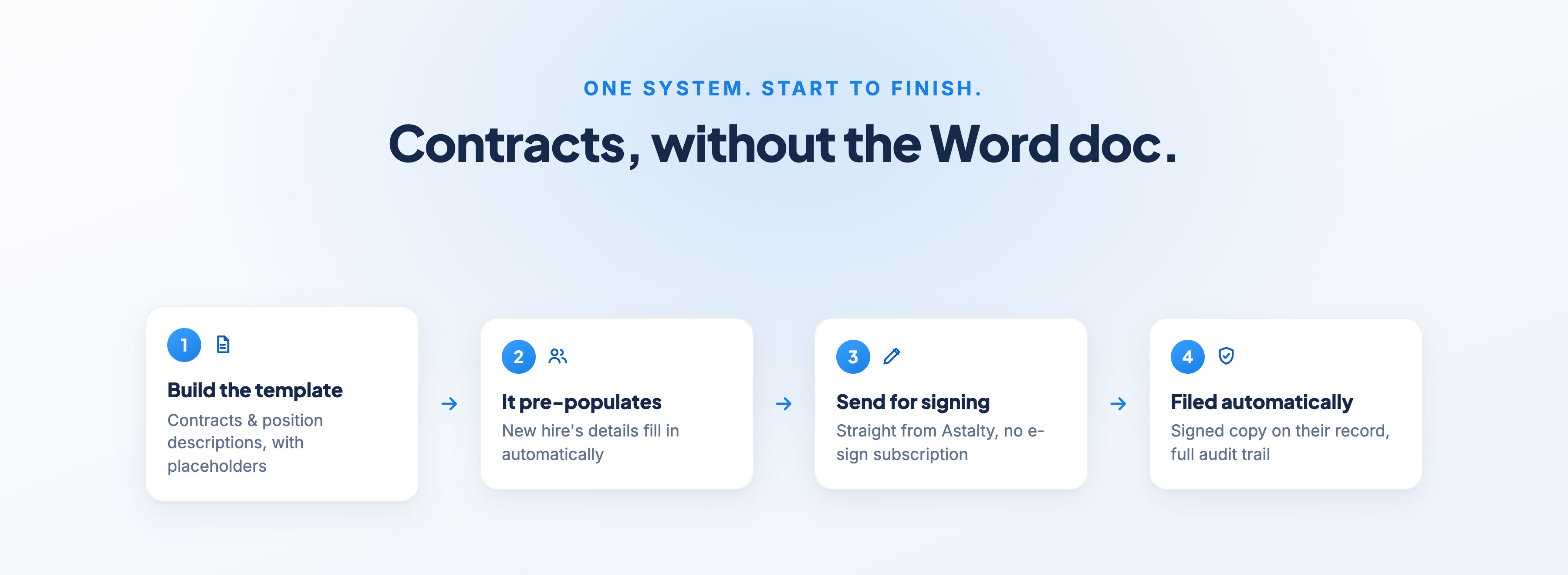
From there, you send it for signing directly from Astalty. No separate e-signature subscription, no exporting to a Word doc, no uploading to another platform. When it's signed, it comes straight back into the system and sits against their record automatically, with a full audit trail.
One system. Start to finish.
Here's how to set it up:
Tracking compliance documents and training
User Records let you track everything you'd normally push into an HR platform: Working With Children Checks, police checks, first aid certificates, NDIS Worker Screening, training, and anything else your organisation needs. You choose exactly which record types to track, set expiry dates, and get notified before anything lapses.
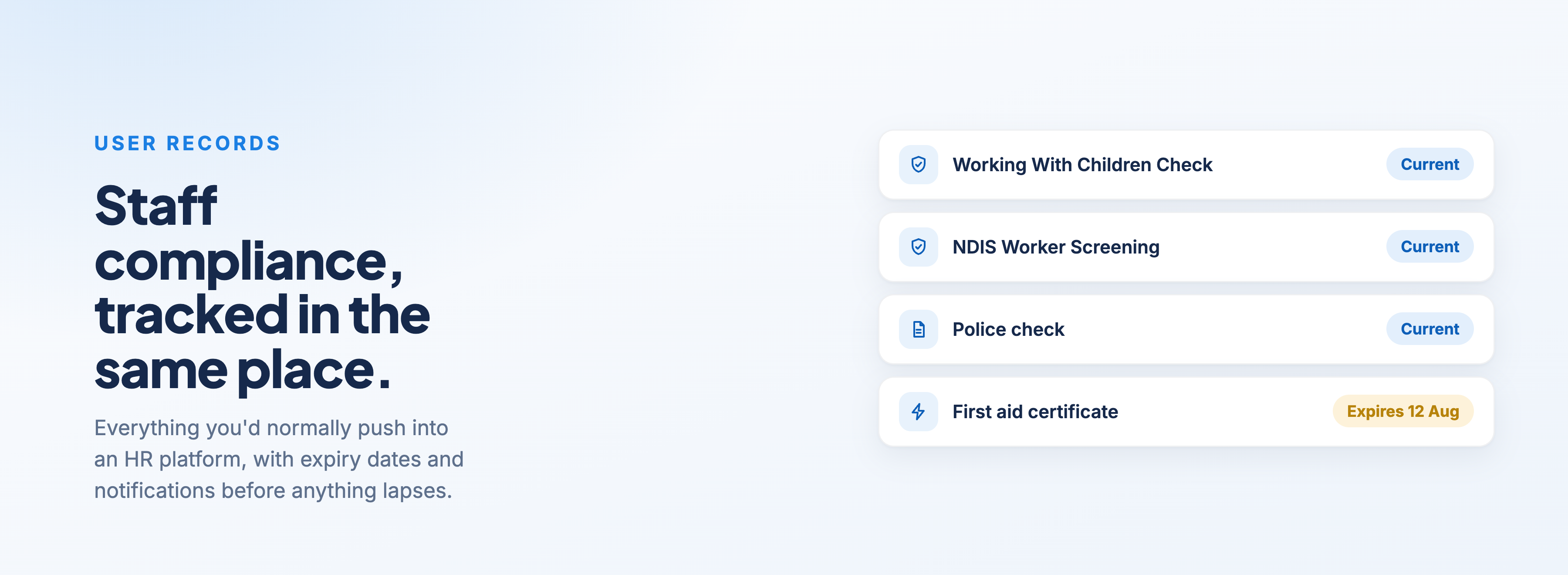
So instead of your HR compliance living in one system and your participant compliance living in another, it's all in one place, with the same reports and the same notifications.
HR-sensitive information, properly controlled
Your team's profiles in Astalty hold their employment details, contracted hours, and pay information under the SCHADS Award, and our scheduling tools interpret worked hours against the Award for payroll. Access to HR details is permission-controlled, so only the people who should see pay and contract information can.
The bottom line
Your staff should have to learn one system, not five. Your compliance documents should live where your participants, rosters, and billing already live. And every subscription in your stack should have to justify itself.
If you're interested in reducing your software stack, have a chat to the Astalty team. Happy to walk you through it.
If you want to see how it would work for your business, you can start a free trial or get in touch, happy to walk you through it.
