
A guide for small NDIS providers on why manual client management breaks down as you grow, and how to move to software-based workflows without the disruption.
Manual workflows don't fail on day one. They fail later, usually right when you're finally getting some traction.
At five staff, a spreadsheet and a shared inbox can just about hold a provider together. At fifteen or twenty, the same setup starts costing you hours every week and creating risk you can't see until it's already a problem. Budgets get tracked by hand. Shifts get filled over text message. Compliance lives in someone's memory instead of a system. None of it is anyone's fault. It's just what happens when a business outgrows the tools it started with.
This is the workflow-by-workflow breakdown of where manual NDIS client management actually breaks down, and what moving to proper NDIS client management software looks like in practice.
Budget tracking that doesn't live in a spreadsheet
Every NDIS provider needs to know three things at any given moment: what's been allocated, what's been drawn down, and what's left. Utilisation, funds remaining, funding periods. That's the whole job.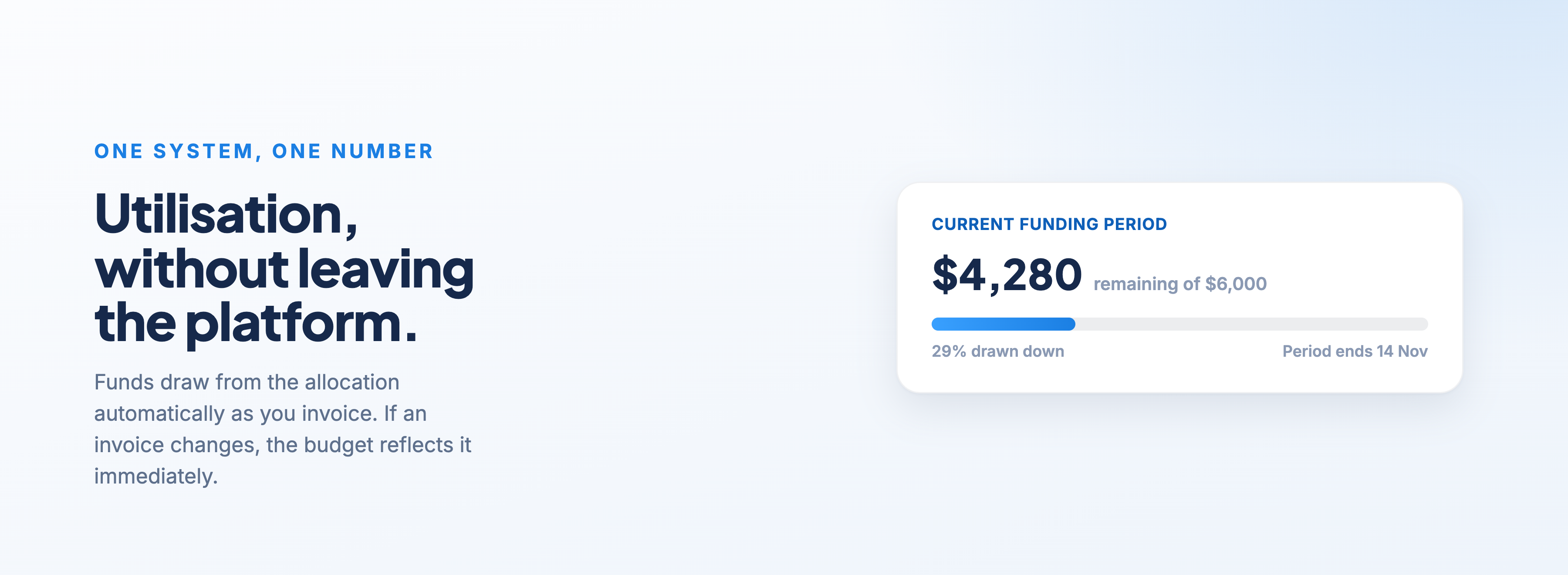
The manual version of this is a spreadsheet, updated by hand, next to whatever's happening in the CRM and whatever's happening in the invoicing system. Three places, one number, and someone has to keep them lined up.
It's error-prone because it depends on someone remembering to update it. And the update isn't a one-off. If an invoice changes or gets declined, that's a manual correction, every time, every week. Multiply that across an entire business and it's a standing admin job that never goes away.
The bigger cost is what it does to your day. If the number you need isn't in the system you're already working in, you have to leave it, go find the spreadsheet, find the right row, and come back. That's not a five-minute inconvenience. Do that a dozen times a day and it's a genuine hole in your time.
Funding periods have made this harder, not easier. Since May 2025, most new and reassessed NDIS plans have moved to shorter funding periods (commonly three months) instead of a single annual budget, and unspent funds carry over into the next period within the same plan, according to the NDIS's own explanation of the change.
That's a big shift in how budgets need to be tracked, and it's been live for over a year now. A lot of provider software still hasn't properly caught up to it. If your system can't show you funding period boundaries the same way the NDIA now structures them, you're back to working it out manually.
In Astalty, the budget gets entered once, at the point you start services with a participant. From there, funds are drawn from that allocation automatically as you invoice. There's no separate spreadsheet to keep in sync, because billing and budget tracking are the same system. If an invoice changes, the budget reflects it immediately.
You see utilisation, funds remaining, and where you sit in the current funding period without leaving the platform.
Shift allocation that doesn't run through your personal phone
If you don't have a system built for this, filling a shift usually means calling someone, texting a few people to see who's free, or dropping a message in a WhatsApp or Telegram group.
It works, in the sense that shifts get filled. But it comes with real problems. We've written before about the privacy issues with running your NDIS business over WhatsApp: participant information moving through a platform your organisation doesn't control, no audit trail, no visibility into what's actually being said. It's worth reading in full if you're still coordinating shifts this way.
There's also a matching problem that a group chat can't solve. Not every support worker should go to every shift. Some participants have preferred workers they want to see. Some staff combinations are flagged as incompatible for good reason. A text thread has no memory of any of that. It relies entirely on whoever's rostering to remember it correctly, every time.
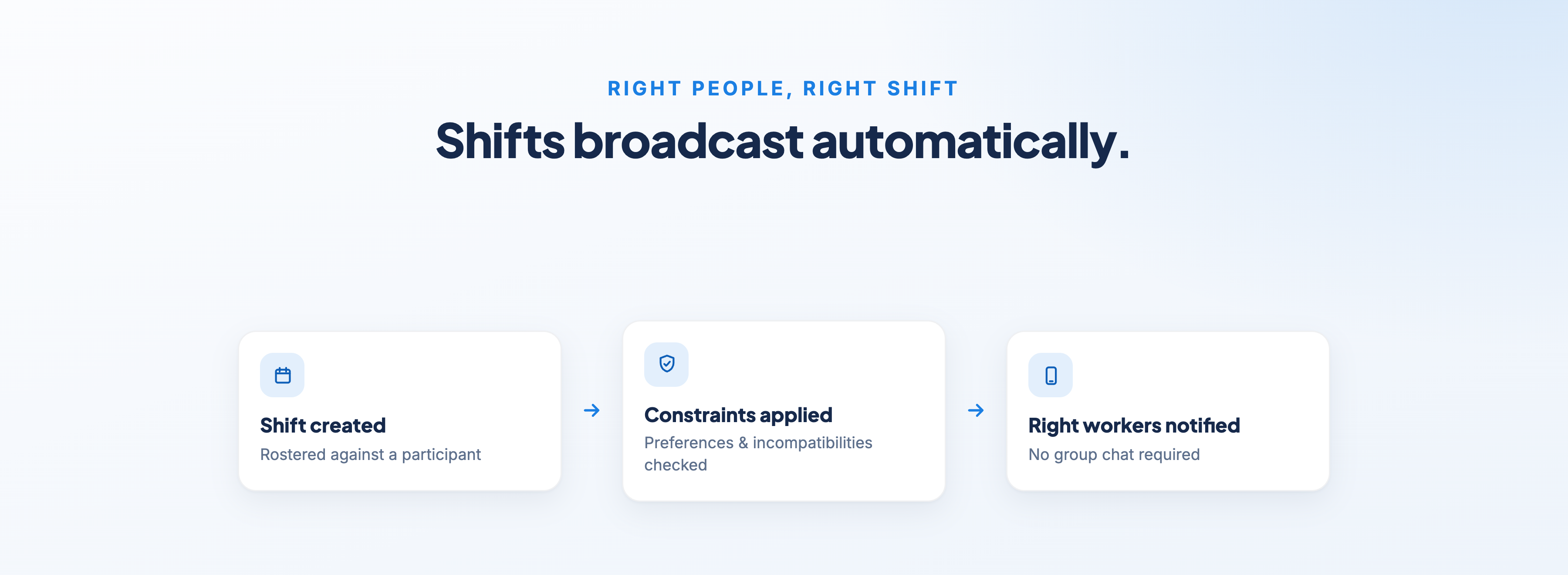
In Astalty, shifts get broadcast directly to the relevant support workers, including preferred staff for that participant. The system also enforces the constraints you've already set: participant preferences get respected, and workers marked as incompatible with a participant or with each other simply aren't offered the shift. The right people end up in front of the right participants, without someone having to hold all of that in their head while they're also trying to fill a roster.
Compliance that doesn't rely on someone remembering to log it
A manual incident register has the same fundamental weakness as a manual budget spreadsheet: it only works if someone goes and updates it. There's no notification when something happens. No prompt to act. If an incident occurs and nobody manually opens the register, it doesn't exist yet, as far as the business is concerned.
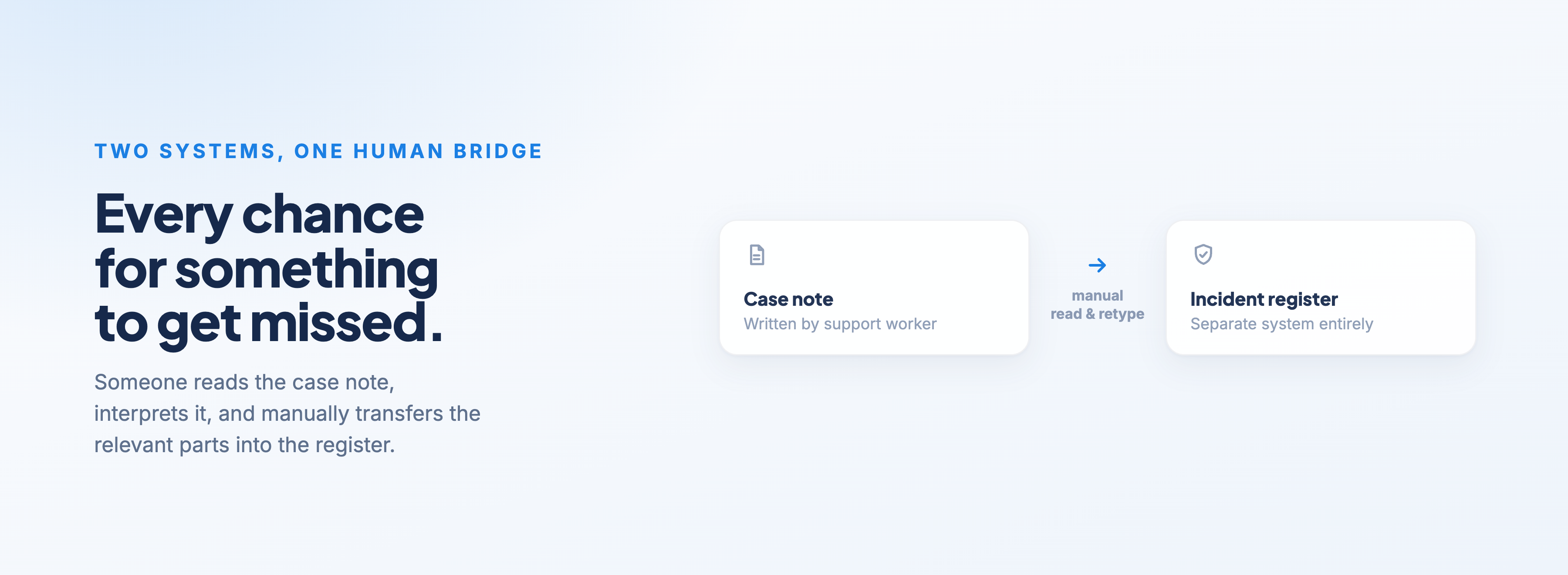
Case notes make it worse. The information about what actually happened is written in one system, and someone then has to read it, interpret it, and manually transfer the relevant parts into a separate incident register. That's two systems, a human in the middle doing the translation, and every chance for something to get missed or written up inconsistently.
None of that should still be manual in 2026.
In Astalty, you build the form once. A support worker submits it, a notification goes straight to the relevant team member, they run the investigation and update the record inside Astalty, and it moves through to finalisation for approval. It's one workflow, in one system, from the moment something happens to the moment it's signed off, instead of a case note in one platform and an incident register in another with someone bridging the gap by hand.
Award interpretation that doesn't cost you hours
Interpreting the SCHADS Award by hand is hard. It's a complex award, the rules interact with each other, and getting it wrong is easy even when you're being careful. Providers without software doing this for them can lose hours working out whether a shift is compliant, and the risk of getting it wrong is high given how much the award covers.
Astalty interprets the award for you, in real time, while you're building the roster. As a shift is created or assigned, the system checks it against SCHADS Award requirements and flags issues before the shift goes live, rather than someone discovering a problem at payroll time.
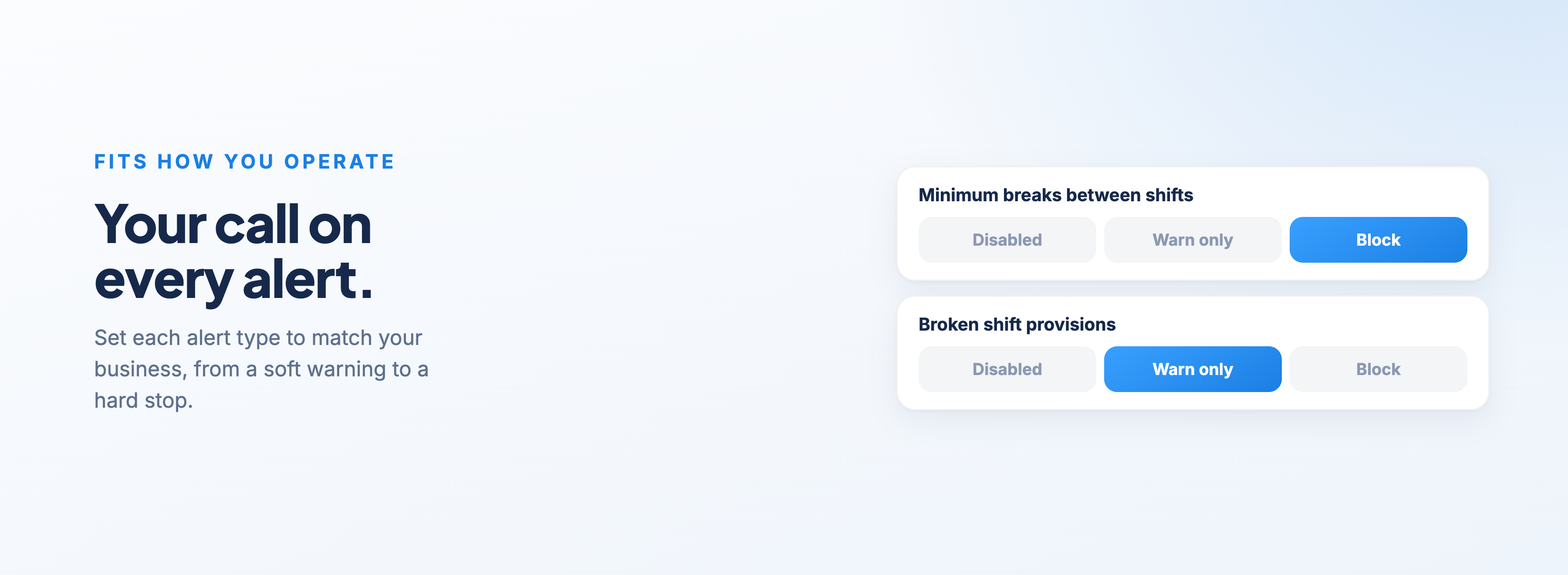
That covers overtime (daily, weekly, and fortnightly caps), rest and fatigue rules like minimum breaks between shifts and required days off, broken shifts, minimum engagement periods, and sleepover provisions. You can set each alert type to disabled, warn-only, or block the assignment outright, so it fits how your business actually wants to operate.
The same award interpretation that powers those alerts also drives payroll exports to Xero, Employment Hero, and PayCat, so what gets flagged on the roster matches what actually gets paid. And when award rules change on a specific date, the system applies the correct version automatically based on the pay period, rather than needing manual reconfiguration. There's also a SCHADS Playground for testing scenarios, like cross-midnight shifts or sleepover calculations, before you commit anything to a real timesheet. Full detail on how it works is in the feature overview and the scheduling documentation.
Where this leaves you
None of these four things breaks a small provider on their own. A spreadsheet here, a text thread there, a register you update when you remember to. It's manageable at a small scale, and plenty of providers run this way for years without a major incident.
The problem is growth. Every new participant, every new staff member, every new shift is another thing for a manual system to drop. The workflows that felt fine at five staff start actively working against you at twenty, and by then you're not just managing a business, you're managing the gaps in how you manage it.
Moving off manual workflows isn't about doing something more sophisticated. It's about the information you already need being where you already are, updating itself, and staying accurate without someone remembering to keep it that way.
If that's where you're at, it's worth seeing what that actually looks like. Book a demo.
