
SIL is operationally complex. 24/7 rosters, multiple participants funded differently under the same roof, not to mention the compliance obligations. Most providers end up stitching together three or four tools to operate their SIL house.
This is what it looks like when SIL is all in one place.
Mixed funding under one roof
Here's a scenario that comes up quite often in product demonstrations.
Three Participants, Three Different ways of funding.
For example,
Three participants in the same house. One is funded on SIL hourly. One is on a weekly ILO rate. One is on assistance with self-care for eight hours a day.
All three are being supported by the same team, on the same roster, in the same building. But each one is funded differently, billed out differently, and uses different line items under the pricing arrangements
Generic platforms don't handle this well. The billing logic is too rigid. So providers end up managing it manually, calculating charges outside the system, entering them by hand, and hoping nothing slips.
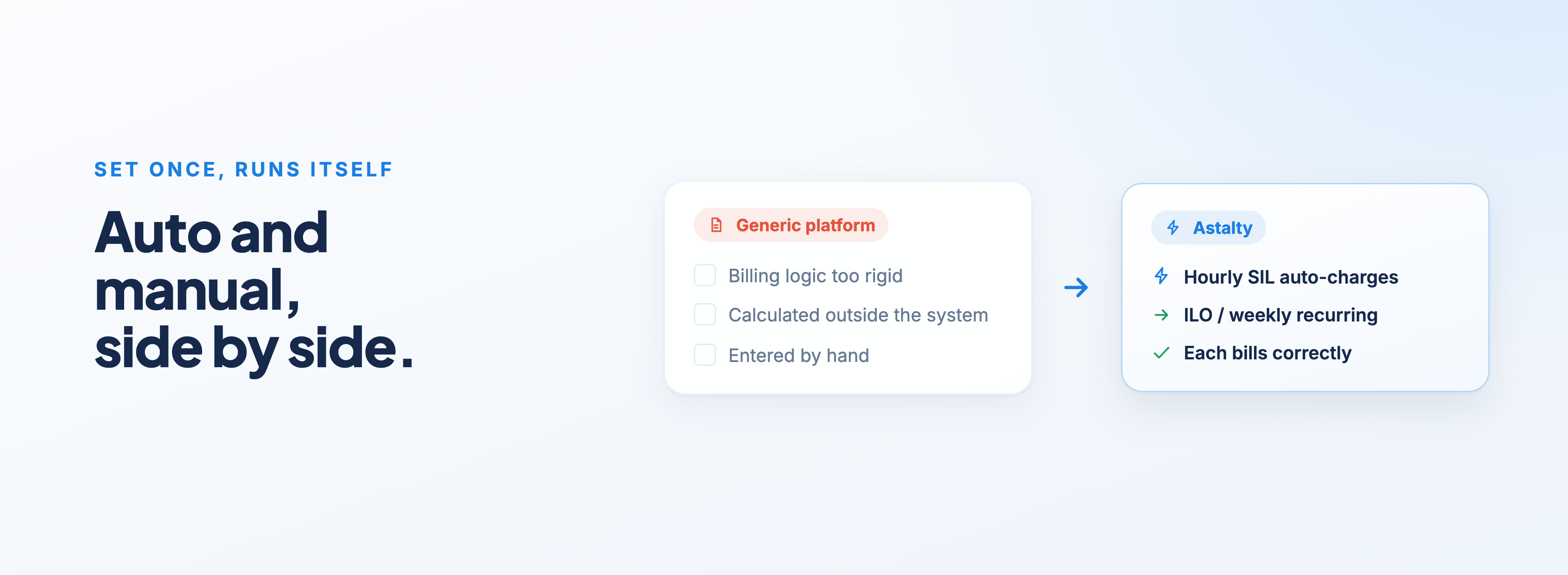
Astalty handles this through a combination of automatic and manual charge modes. Participants on hourly SIL auto-charge based on time of day. Participants on weekly or ILO rates run through recurring charges set up separately. Each person bills correctly, from the same system, without anyone bridging the gap manually.
All drawing down from their utilisation from within Astalty, so your team can keep a close eye on remaining funding and ensure over-exhaustion of funds doesn't occur.
Paying people correctly without the admin chain
The typical process for a sleepover activation looks something like this.
The worker wakes up at 2:00am, a participant needs support. They send an email or a message to the coordinator the next day.
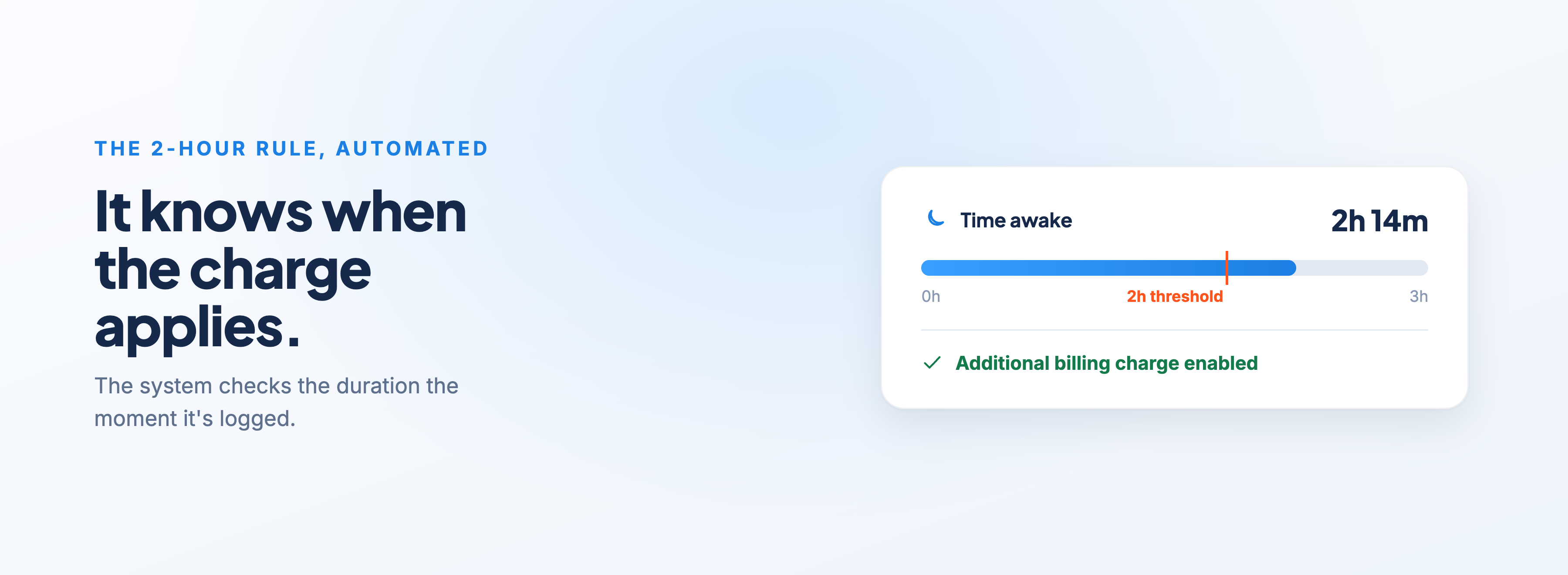
The coordinator logs it the next morning, fills out a form, and hands it off to whoever manages timesheets. That person checks the hours, creates the entry, and then someone has to work out whether the time crossed the two-hour threshold that enables the additional billing charge.
Four people. Multiple steps. All of it manual. And if anything in that chain gets missed, the charge either doesn't go out or it goes out wrong.
In Astalty, the worker logs it directly through the app, adds the start time, end time, and the reason for the activation. The system checks the duration. If it's over two hours, the billable item is created automatically, and pay is adjusted to reflect the time awake.
One workflow, made easy.
Keeping the team in the loop
Many SIL teams default to WhatsApp or Facebook Messenger for house communications. It fills the gap, but it creates real problems.
The first is compliance. Both platforms store data offshore, which puts you at odds with the Australian Privacy Principles. If participant information is being discussed in those chats, and it will be, that's a problem worth taking seriously.
The second is control. There's no audit trail.
No way to review what was said and when. And when someone leaves the organisation, they don't lose access to those messages. They can still read the history. They can still message people in your team.
Astalty has built-in chat. Direct messages and group channels, set up per house or per team, all sitting inside the platform. When a staff member is offboarded, access goes with them. Everything is searchable and stays where it belongs, next to the roster and the billing, not on someone's personal phone.
Knowing what the house actually costs
Most providers piece together their house finances at the end of the quarter with their accountant or bookkeeper. Pulling figures from their scheduling tool, their accounting software, and a spreadsheet.
By the time the picture is clear, they're already three weeks into the next billing cycle.
That delay matters. A house running at a loss doesn't announce itself early. It shows up in the numbers when it's already too late to adjust rosters, have a conversation about costs, or make any meaningful change to that period.
Astalty's scheduling costs feature brings wages and revenue together in real time.
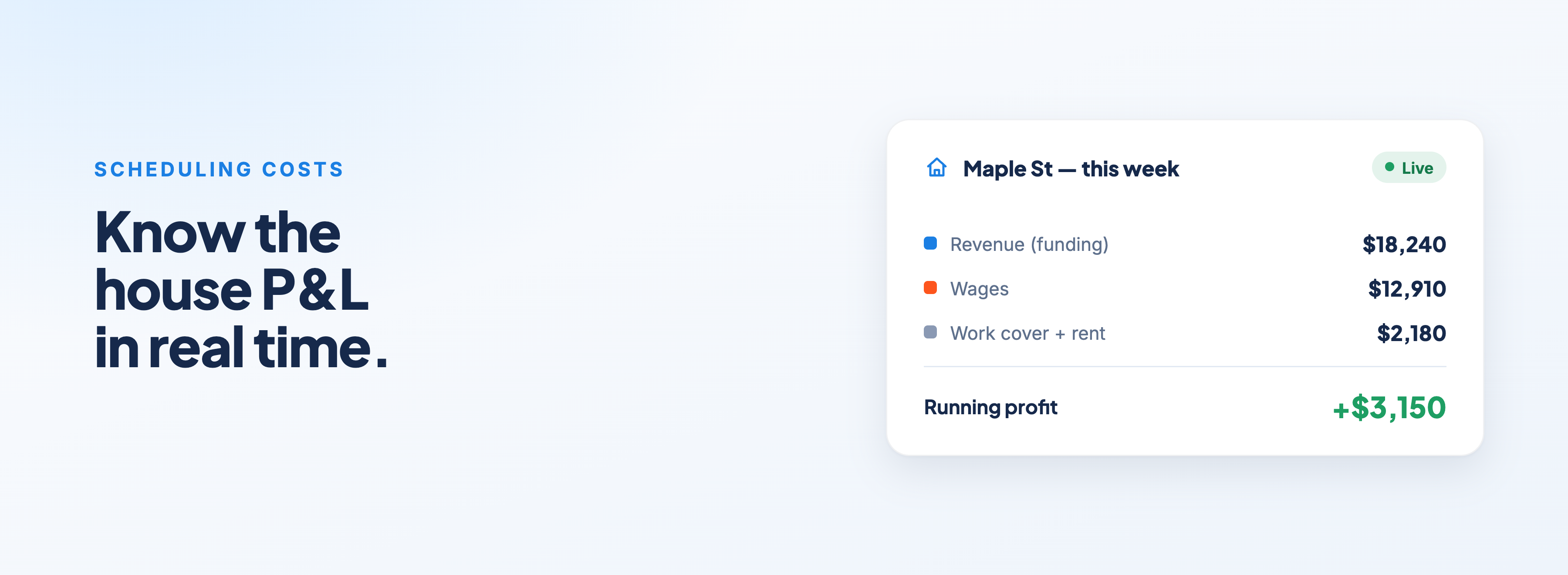
Fixed and percentage-based costs can be added against the schedule, work cover as a percentage of payroll, weekly rent as a fixed amount, and you get a running view of profitability per site. The same applies to participant funding utilisation. If someone is burning through their plan faster than expected, you can see it before the funds run out, not after.
If a house is tracking toward a bad month, you see it early enough to do something about it.
One system instead of four
Providers find workarounds for all of it. The issue is the cost of running those workarounds every day, across every house, across every shift.
Astalty was built for NDIS providers, by people who ran NDIS businesses. If you're managing SIL across multiple platforms right now, it's worth seeing what one system looks like.
