
The SCHADS Award is, by the Fair Work Commission's own admission, not a clear document. In a recent ruling, the Court described its drafting as lacking "clarity and precision." That's the government body that wrote it, acknowledging it's hard to follow.
Most providers who get caught genuinely thought they were doing it right. The problem is that SCHADS is complex enough that you can be trying hard and still be wrong.
Here are the three areas where we're seeing providers come unstuck in 2026.
Worker misclassification: the error that compounds every single pay run
Classifying your support workers correctly is the foundation of SCHADS compliance. Get it wrong, and every shift paid since that point is potentially an underpayment.
There are four separate streams under the award, Social and Community Services, Home Care, Crisis Accommodation, and Family Day Care. Within those streams, there are multiple levels and pay points based on qualifications, experience, and the actual duties being performed. A worker's paperwork might say one thing. Their day-to-day responsibilities might technically place them somewhere else.
The Fair Work Commission reviewed this in 2025 and found the classification system was so complex that it was directly contributing to widespread misclassification across the sector.
Their words, not ours.
Common misclassification mistakes include putting workers under the Home Care schedule when they should be under SACS (which carries higher rates), starting workers at Level 1 when their qualifications or duties warrant Level 2, and not reviewing classification as workers take on more responsibility over time.
Pay point progression adds another layer. Under the award, workers in most streams become eligible for pay point progression after 12 months of continuous service and satisfactory performance.

Eligible isn't the same as automatic; the Federal Circuit Court has confirmed there's no strict obligation to move a worker up just because 12 months have passed. The employer still has to assess and make a determination. But if you don't have a process for tracking when that mark hits, you don't even know when to make the call. Workers sit at the same pay point indefinitely, the review never happens, and whether that becomes a compliance issue depends on what your internal records show.
The fix is straightforward in principle: review your current workforce against the actual classification criteria, not job titles or what was written in an employment contract years ago, and make sure you have a process for flagging when progression reviews are due.
Broken shifts: there's more to it than you think
Broken shifts are a daily reality for most providers. A worker does a morning shift, has a few hours off, and comes back for an afternoon or evening shift. Seems simple enough.
The SCHADS Award makes it significantly less simple.
Every broken shift triggers a mandatory broken shift allowance, $20.12 (in April 2026) for one unpaid break, $26.63 for two. That allowance applies every single time, on top of the worker's hourly rate. Providers running manual payroll routinely miss it because it isn't captured unless there's a specific process in place.
Beyond the allowance, there are rules that aren't obvious:
The minimum engagement per portion of a broken shift is 2 hours for home care workers, 3 hours for SACS employees. If you roster someone for a 90-minute shift, you're paying for 2 hours whether you mean to or not.
The total span of a broken shift can't exceed 12 hours. If it does, the final hours get paid at double time, not the standard rate.
Workers need a minimum 10-hour break between shifts on consecutive days. If that break isn't there, it changes how the following shift gets classified. The one exception: if the preceding shift included a sleepover, the break can be reduced to 8 hours by written agreement between employer and employee.
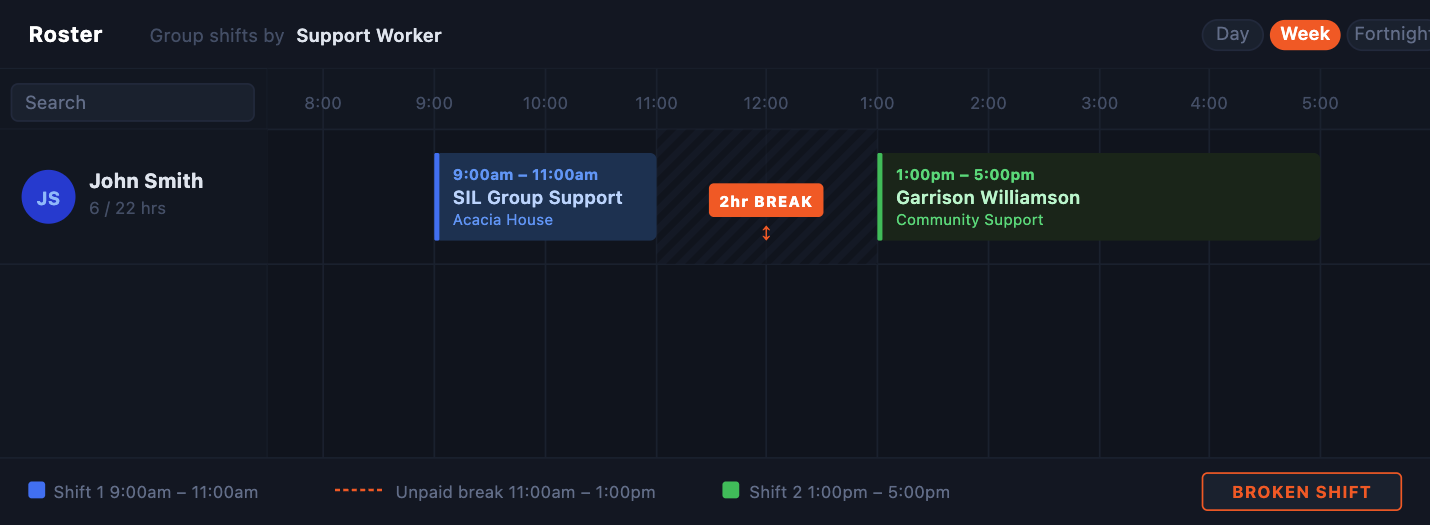
If your rostering and payroll systems don't specifically flag and calculate broken shift allowances as a line item, there's a good chance this is happening in your business right now.
Sleepovers: there's an active legal battle happening, and providers are caught in the middle
Sleepovers are complicated at the best of times. Right now, they're in a genuinely uncertain legal position, and providers need to know about it.
Here's the background. For years, the Fair Work Ombudsman's guidance was that a sleepover and the hours worked before and after it formed one continuous shift. If that combined period crossed midnight, the 15% night shift loading applied to the ordinary hours on either side.
In July 2025, the Federal Court disagreed. In the Jats Joint case, the court ruled that sleepovers are separate and distinct from the surrounding shifts and don't trigger the night shift loading for hours worked before and after them. The FWO appealed. In March 2026, the Full Federal Court dismissed that appeal and upheld the original decision.
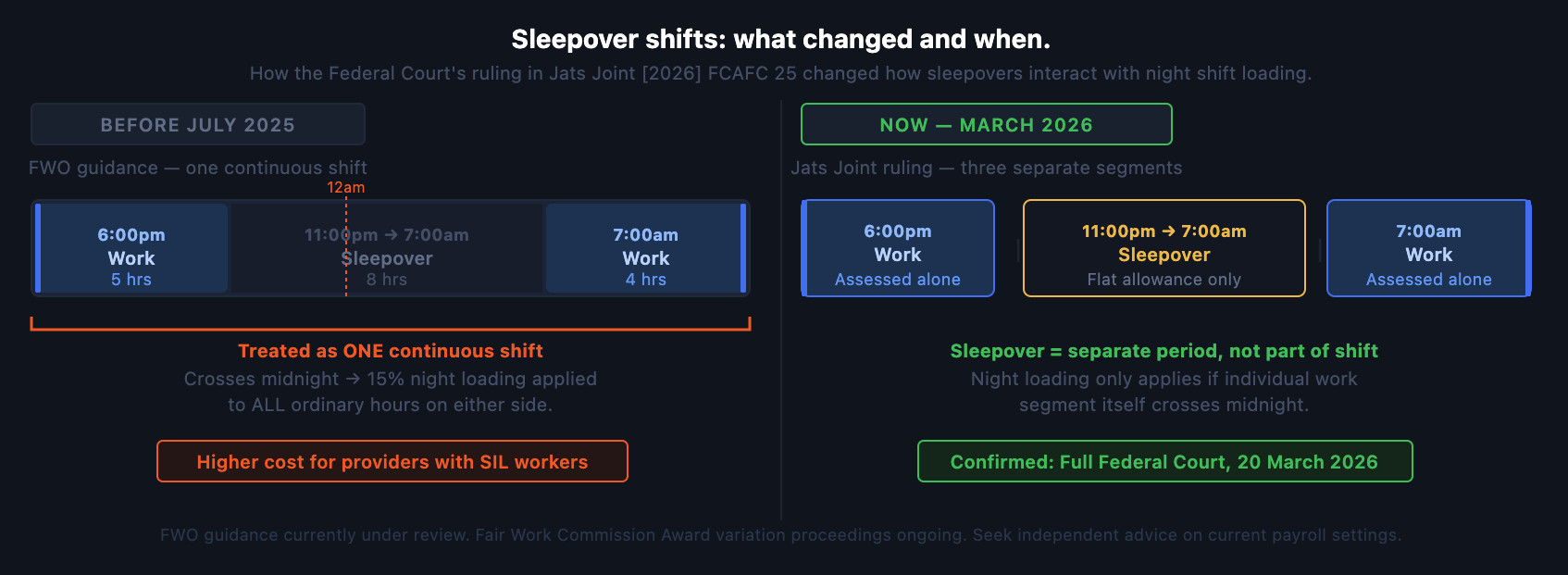
So as of now, the current legal position is that sleepovers don't attract the night shift loading for hours worked on either side. This is the opposite of how many providers have been paying, and the opposite of what the FWO told them to do.
The Fair Work Commission is also in the process of varying the SCHADS Award provisions around sleepovers to try to resolve the ambiguity permanently.
That process is ongoing.
What this means practically: if you're running SIL or have staff working sleepovers regularly, your payroll settings from six months ago may now be wrong, but the guidance on what "right" looks like is still being finalised. The best thing you can do is review your sleepover configurations against the current Federal Court position, not the old FWO guidance, and keep a close eye on further developments.
The flat sleepover allowance still applies. Work performed during the sleepover still triggers overtime with a minimum payment of one hour. None of that has changed. It's specifically the night shift loading on the pre- and post-sleepover hours that's been contested.
What to actually do about this
The honest answer is that manual payroll and spreadsheet-based rostering can't reliably handle SCHADS compliance at this level of complexity. The rules interact with each other in ways that aren't visible until after the fact, and by then, you're already in underpayment territory.
A few practical steps:
Audit your classifications now.
Pull your workforce list and check each person against the actual SCHADS classification criteria, stream, level, pay point, and whether progression reviews are overdue. Don't rely on what's in contracts from when they were hired.
Check your broken shift process.
Is there a specific line item in your payroll for broken shift allowances? If you can't answer yes immediately, it probably isn't there.
Review your sleepover configurations.
If your system is applying night shift loading to hours on either side of a sleepover, that needs to change in light of the Jats Joint decision. Confirm your payroll provider's current position.
If you want to see how Astalty handles SCHADS compliance, including our SCHADS Playground for checking pay rates across shift types, we're happy to walk you through it.
Sources
SCHADS Award MA000100, Fair Work Commission — clauses 13.3 (pay point progression), 20.12 (broken shift allowances), 25.6 (broken shift rules), 25.7 (sleepovers), 29.3(b) (night shift loading). Rates per the Fair Work Ombudsman Pay Guide, effective 1 October 2025.
Jats Joint Pty Ltd v Fair Work Ombudsman [2025] FCA 743, Federal Court of Australia, 8 July 2025.
