
Let's be honest, the NDIS space is tough right now.
Labour costs are largely fixed. What you can charge is fixed. Margins are thin, and providers are leaving the market faster than most people are comfortable talking about. If you're running a disability support business in 2026, sustainability isn't just a nice word to put in your mission statement; it's the whole game.
So when you're evaluating rostering software, the question isn't just "does this do what I need?" It's "does this help my business still be here in five years?" That's the lens we're going to use today.
Here's what we think actually matters.
SCHADS Award Alerts: The One That Can Save You Thousands
If you've ever sat down and actually read the SCHADS Award, you'll know it's not exactly a light Sunday afternoon read. It's complex, it's nuanced, and the penalties for getting it wrong don't care whether you made a mistake on purpose or not.
This is where NDIS rostering software can either earn its keep or completely miss the point.
The best platforms will flag award issues before you publish a roster, not after a payroll run has gone through and someone's disputing their pay.
What you want to be looking for:
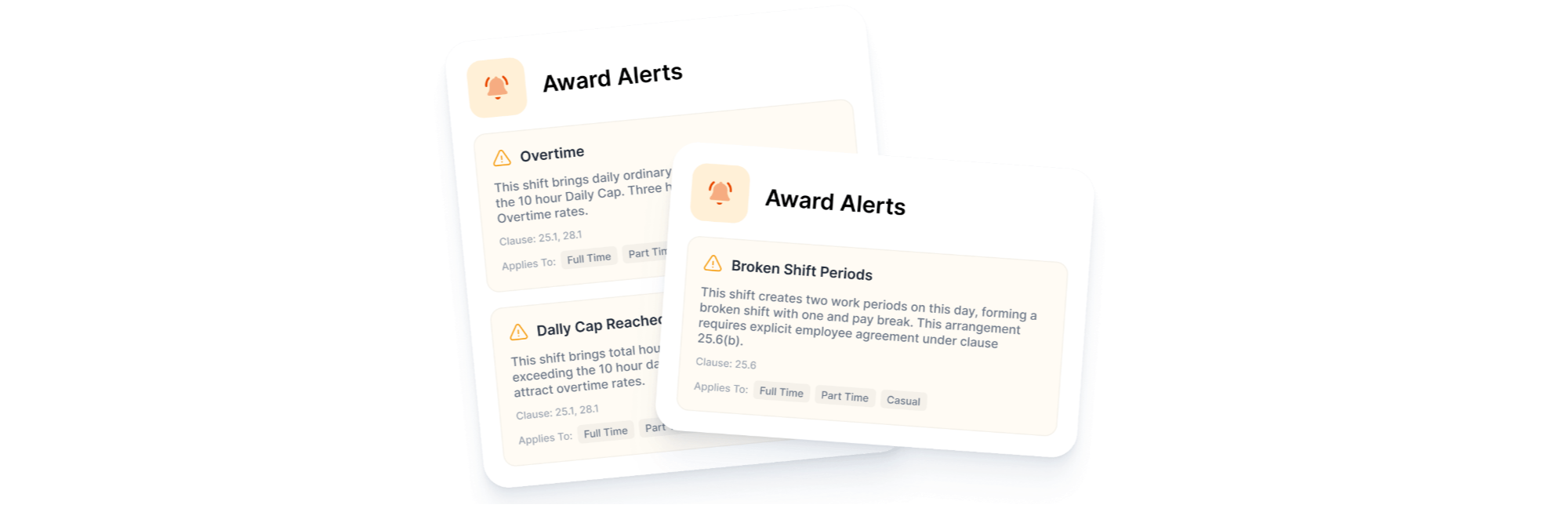
Broken shifts — where a split shift doesn't meet minimum break requirements
Overtime — when a shift pushes a worker over their daily or weekly hour cap
Fatigue management — insufficient breaks between shifts, minimum rest periods
Shift duration — when a shift runs long enough to trigger a higher pay rate
These aren't edge cases. For providers running reasonably sized teams, these issues come up constantly. And they add up. We're talking hundreds, sometimes thousands of dollars per week in unnecessary overhead.
Multiply that by 52 weeks, and it's a number that makes you want to sit down.
The goal isn't to turn your rostering coordinator into a SCHADS expert. The goal is to give them a system that guides them, flags the issues, and lets them fix things before they cost you money.
If you want to see how much you could actually be saving, check out our SCHADS savings calculator. Plug in your numbers, and it'll give you a real figure and a downloadable PDF.
If you're interested in how Astalty handles this specifically, you can read more about our Scheduling Award Alerts here.
Participant Preferences: The Retention Play Nobody Talks About
Everyone in this industry talks about growth. New participants, new referrals, new revenue. What doesn't get nearly enough airtime is retention, and honestly, there's no point filling the bucket if it's got holes in it.
Keeping a participant is significantly easier (and cheaper) than finding a new one. And the most basic thing you can do to keep a participant? Make sure they're happy. And the most basic thing you can do to make sure they're happy? Make sure their support actually meets their needs.
This is where participant preference matching in your rostering software becomes a genuinely powerful tool.
Good software should flag compatibility issues at the point of rostering. Before the shift is assigned. Not after the participant calls to say they weren't happy, and not after a complaint is lodged.
And it needs to be nuanced about it, because people are nuanced. Some preferences are hard NO’s, others can be specific to gender, age, language, history. Others are more like soft preferences, "I'd prefer a female support worker, but it's not the end of the world if that's not always possible." Your rostering tool should be able to handle both, and communicate the difference clearly to whoever's building the roster.
Get this right, and you're not just building a compliant roster, you're building a roster that actually keeps participants happy, and with your service long term. That's a retention strategy hiding inside a scheduling feature.
Automation: Please, Reduce the Stack
Here's a story. When I used to do support worker inductions, I'd sit down with a new team member and walk them through all the different systems we used:
One for payroll
One for posting available shifts
Email for this, email for that
A separate place for policies and procedures
Another one for scheduling and case notes
And you could just see it on their faces. That glaze. That very specific look of someone trying to hold too many things in their head at once and already wondering if this job is worth it.
Too many NDIS providers are running their business on a patchwork of disconnected tools, and it's costing them in admin time, errors, staff confusion, and, eventually, people walking out the door.
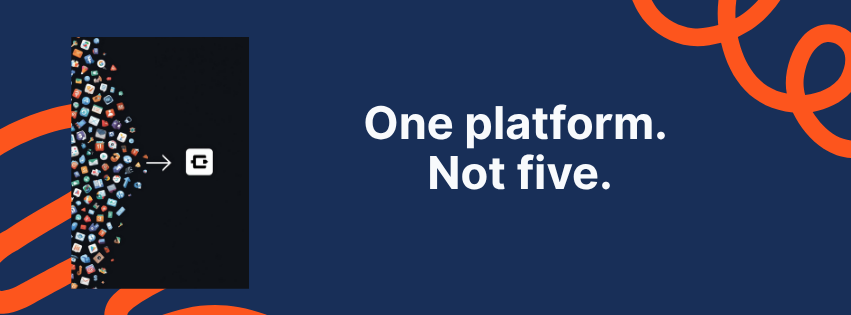
Good NDIS rostering software in 2026 shouldn't just roster. It should connect to the rest of your operation: timesheets that flow to payroll, invoices that sync to your accounting software, compliance documentation that lives in the same place as your participant records.
The less your team has to jump between systems, the faster things get done and the fewer things fall through the cracks.
When you're evaluating platforms, ask this question: how many of my current tools does this replace? If the answer is one, it's probably not doing enough.
AI… Real AI, Not Just a Chatbot with a Hard Hat On
AI is the buzzword of the moment, and honestly, a lot of what's being marketed as "AI" in the NDIS software space right now is just workflow automation with a fresh coat of paint.
Automations are useful, don't get me wrong, but they're not the same thing.

Real AI has the potential to do something genuinely different for providers. And here's where I'll admit I might be getting a little ahead of myself, but stay with me.
Imagine software that could:
Summarise incident reports from the last six months and identify trends before you write your next internal audit report
Pull together case notes across a participant's plan period and draft a progress report for plan review
Flag when internal audit tasks are overdue and chase them automatically
Identify which participants are at risk of disengaging based on patterns in their service delivery data
Maybe a software provider should develop these - subtle hint for the dev team
Okay, yes, some of that might be a 2027 conversation.
But the direction is clear, and providers who find platforms that are genuinely investing in this capability (not just using the word) are going to have a significant edge on the admin overhead problem that's been quietly strangling the sector for years.
When you're evaluating rostering software, ask the vendor: what does your AI roadmap actually look like? What's live now versus what's on the horizon? The difference between a marketing slide and a working feature matters a lot when you're signing up for a platform you'll rely on every day.
The Short Version
If you're evaluating NDIS rostering software in 2026, here's what we'd keep front of mind:
SCHADS award compliance built in — not as an add-on, not as a report you run after the fact, but as real-time alerts that stop issues before they become payroll problems
Participant preference matching — nuanced enough to handle both hard and soft preferences, flagged at the point of rostering
Genuine automation — software that reduces your stack and connects your roster to your timesheets, payroll, invoices, and compliance in one place
A credible AI roadmap — not buzzwords, but real capability that's reducing the admin burden your team is carrying right now
The NDIS isn't getting simpler. The providers who are still standing in five years will be the ones who found smarter ways to run their business — not just harder ways. The right rostering software is part of that.
If you want to see how Astalty stacks up on all of the above, start your free 14-day trial here
